TEXTILES.ORG





A social media presence has become ubiquitous for nearly every type of business. And while that constant presence may be beneficial, social media interaction can become stale, routine and consequently less effective. For a company that has been engaged with social media for multiple years, it may be time to take a fresh look at how to utilize this tool.
As Sydnie Kelley, creative director for Career Potential LLC, headquartered in Augusta, Ga., explains, a common mistake companies make is failing to clarify ahead of time exactly what they want to accomplish via their use of social media. Instead, they jump onboard, feeling they must because “everybody else is doing it”—a mindset that doesn’t always work to their advantage.
“With no main goal or direction for your social media presence, it can actually make your company lose credibility, professionalism and potential customers because of its undefined messaging or storyline, and unorganized look and feel,” Kelley says. Career Potential offers speaking, training and consulting services to individuals and organizations, along with leadership development skills and strategies.
Devising an overall social media goal and strategy as well as identifying the target audience can help companies determine which platforms are going to deliver the best results, she says. Once those parameters have been defined, a business needs to figure out who the typical users are of whatever platforms it’s considering, and how closely the platforms match those with whom the company hopes to connect. Other considerations include what comprises the “optimal content for that platform” and if the company will be able to effectively execute that content, Kelley says.
For example, younger people tend to use Instagram and TikTok, whereas an older audience is likely using Facebook. Facebook is a good platform for posting “awareness content” such as company events and important milestones, she says. It’s also useful for brand-building and maintaining a consistent image. On the other hand, Instagram relies on “visually engaging” videos or photos. Then there’s LinkedIn, which can reach younger and older professionals alike.
“Think of [this] as your networking breakout session at a conference,” Kelley advises. “Keep it professional and credible yet approachable. This is often the place users go to find more information about what it is like to work for or with your company.
“It is our recommendation to use all tools,” she continues. “But make sure you customize your message and delivery for each audience.”

Targeting the targets
For companies that have so far resisted the use of social media, it may be time to reevaluate that stance, particularly if there’s a concern over how to replenish the workforce with younger employees. Social media is an especially important vehicle for those wanting to get the attention of this demographic, says Melissa Furman, Ph.D., president and founder of Career Potential.
“Most younger workers use social media more than they use websites or even search engines like Google,” Furman says. “If you don’t utilize social media, it could impact your credibility with younger employees, and you are missing an opportunity to use a critical recruiting tool to attract and retain younger workers.”
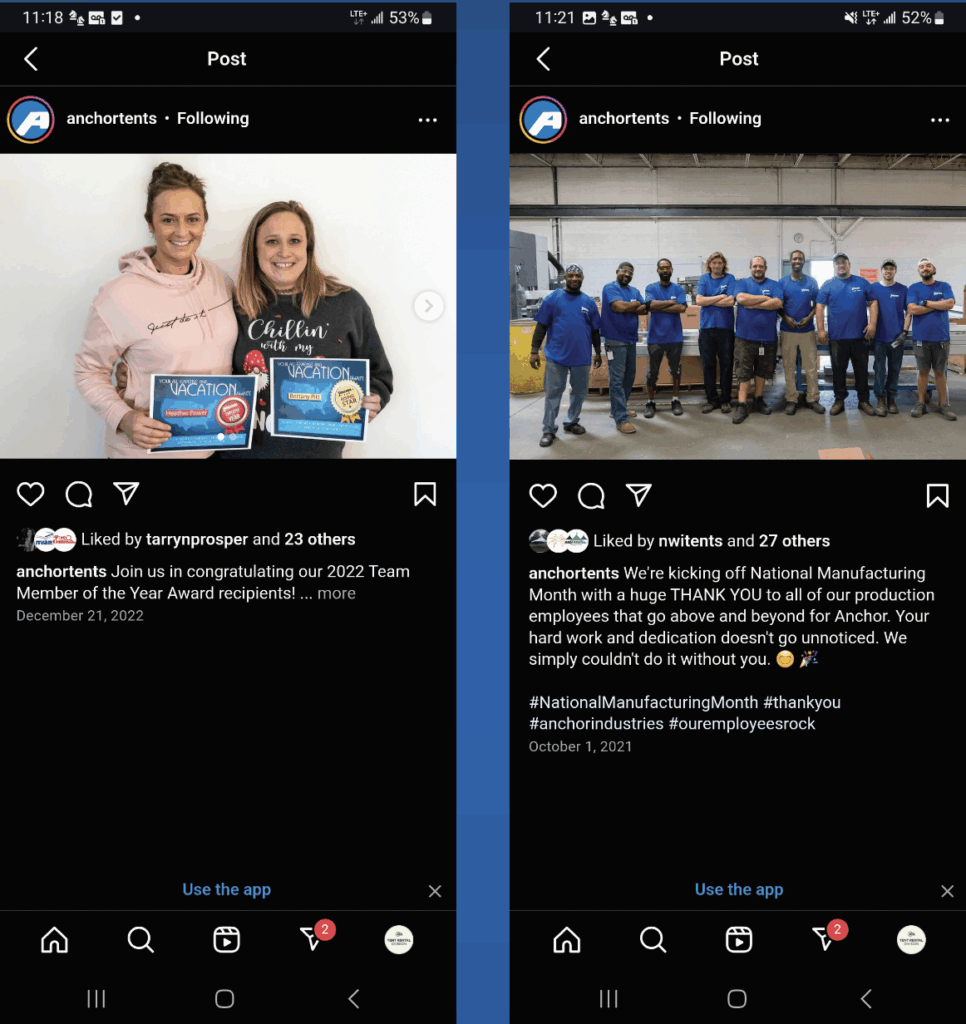
Consider Anchor Industries Inc. Located in Evansville, Ind., Anchor provides tents, shade structures, custom fabric/frame products and more. Marketing coordinator Haley Shoulders says the company began using Facebook in 2010, adding YouTube in 2011, Instagram in 2017 and TikTok in 2022. (Anchor also uses LinkedIn, but Shoulders is uncertain as to when this started.)
“Anchor wants to meet customers where they are,” she explains. “The current and next generation of rental owners are more than likely on social media, so we shifted some of our marketing to these platforms. We think that by using the multiple advantages of social media, we can reach a broader and more diverse audience and target specific groups more effectively.”
Using different platforms not only gives the company more visibility, it allows the business greater content flexibility. For example, on Facebook and Instagram, it posts things such as customer highlights, product launches and “exciting news.” These vehicles also celebrate employees and find potential clients. Consisting of short videos, TikTok serves a less serious purpose, while LinkedIn is used for recruitment, for announcing product launches and touting customer achievements. As for YouTube, although Anchor’s channel has been up since 2011, Shoulders says the company started using it more frequently in 2020.
“The kinds of videos we post are the launching of new products, installation instructions for our customers, employee spotlights, meet-the-team shorts, company events and parties,” she says. “We tend to keep these videos short—usually under three minutes unless they require more in-depth explanation, like our install videos.”
What does she make sure not to post? Anything controversial or negative (especially about competitors), inappropriate humor or jokes, personal opinions and content that is overly promotional, the latter of which can turn off followers.

Recruiting clients and employees
Joseph Sandone, vice president of Dallas, Texas-based Sandone Productions, says the company has been using Facebook for approximately 15 years. Over the last two years, the company has added Instagram, TikTok and Pinterest. The main objectives are building awareness and generating interest for the company, which specializes in high-end tented events, large-scale projects and custom structures, says Sandone.
“We’ve also seen unexpected recruiting benefits, a welcome bonus to the effort,” he adds. “We primarily post photos and reels from event installations and some behind-the-scenes footage. We may post company updates when relevant, but not frequently.
“I’m a proponent of giving people what they want,” Sandone continues. “Your social media audience would much rather see an incredible holiday event than a generic ‘happy holiday’ post.”
What types of posts garner the most interest? Before-and-after transformations, unique design elements and anything people want to share with their friends or save and return to do well, Sandone says, adding that the company’s Cathedral structure seems to have the highest engagement.

Sandone Productions also uses social media to show potential clients some of its more “impressive” projects to highlight its capabilities and let potential clients know that they will travel to other parts of the country. Making this clear helps the company attract new clients/business and allows it to further hone its brand as experts in “destination event productions,” he explains.
With their typically abundant content, event planners are great resources while at the same time making the guidelines for posting very clear. If the planner and photographer post about an event, Sandone says the company feels comfortable sharing those images. However, he adds, if a client wishes to preserve privacy or hold back photos/videos for later publication, the company respects those boundaries.
“We’re lucky to be frequently involved in extraordinary projects, often in beautiful locations, supported by other immensely talented partners and captured by exceptional photographers,” he says. “Sometimes the posts just take care of themselves.”

Learning curve
To keep everything organized and on track, Sandone relies on an outside marketing agency. He does oversee and approve the work but prefers to take a “light touch” and let the experts handle it whenever possible.
Shoulders, one of three people on the Anchor marketing team, manages the company’s social media. “We have not created a position that just focuses on social media,” she says, adding this task comprises a small part of her duties. “For a while, we didn’t have anyone to shoot or edit videos on our team. Our YouTube and website lacked because of that. We eventually outsourced projects and I have been taking the time to learn myself.”
The team didn’t purchase any special equipment for its social media efforts, she continues. But one thing that did “elevate” efforts was buying a drone. This enabled them to take interesting and unique shots at different angles of the company’s installs, adding a “wow factor” to photos and videos.
Sandone also bought a camera drone for social media purposes. “It’s in a tree in Arkansas,” he says.

Controlling and customizing content
Shoulders and Sandone control what is posted on their platforms. For most companies, this is the optimal approach. It not only removes the risk of posting activity by employees that could undermine the company’s reputation, it also eliminates the need to monitor what multiple staff might be sharing on the organization’s social platforms. This can help avoid problems since, as Furman observes, “there are legal implications and organization-specific implications” when it comes to monitoring employee activity.
It’s also important to get an employee’s permission before posting something about that person—for example, a recognition or achievement, Kelley notes. “Depending on your company’s goal for being on social media in the first place, if this type of content aligns with your strategy, then absolutely post employee highlights,” she says. “For example, if your goal is to recruit and retain employees, then this type of content reinforces that goal. However, if your goal is to make sales, then this content does not align with that goal.”

Sandone emphasizes the importance of evaluating content with the platform in mind. For example, rather than static photos of large-scale projects or festivals and posting these on Facebook or Instagram, consider taking behind-the-scenes or transformation videos for YouTube, where audience engagement might be higher. Instagram and Pinterest are good for showcasing luxury weddings and high-end events.
“Remember that you’re advertising to a moving parade, not a standing army,” Sandone says. “You may think everyone knows your inventory or the events you’ve been a part of because you shared them once in the past. But in reality, only a fraction of your followers see the things you’ve shared, and even fewer remember them for more than a day. Feel free to reshare from the archives and remind folks of what you can do.”
Pamela Mills-Senn is a freelance writer based in Seal Beach, Calif.
SIDEBAR: Be sure to…
Haley Shoulders, marketing coordinator for Anchor Industries Inc., Evansville, Ind., provides the following tips for tent and event rental companies that want to sharpen their social media presence:
- Know your audience demographics and tailor your content accordingly.
- Be consistent and patient with posting because attracting followers requires both.
- When appropriate, reuse content across platforms.
- Use high-quality images and provide education when possible.
- Demonstrate engagement by responding to comments, messages and so on. Be transparent, professional and concerned when addressing negative feedback.
“Make sure you have a good mix of products and installs to showcase, and balance promotional content with value posts that engage and inform your audience,” Shoulders advises. “I also make it a point to only post tent installs that are installed to our certified installations instructions and that use correct ballasting.”